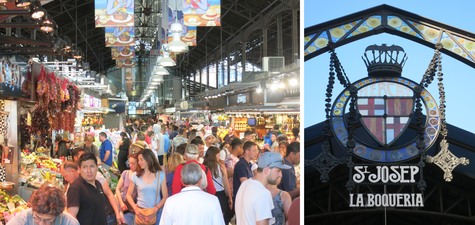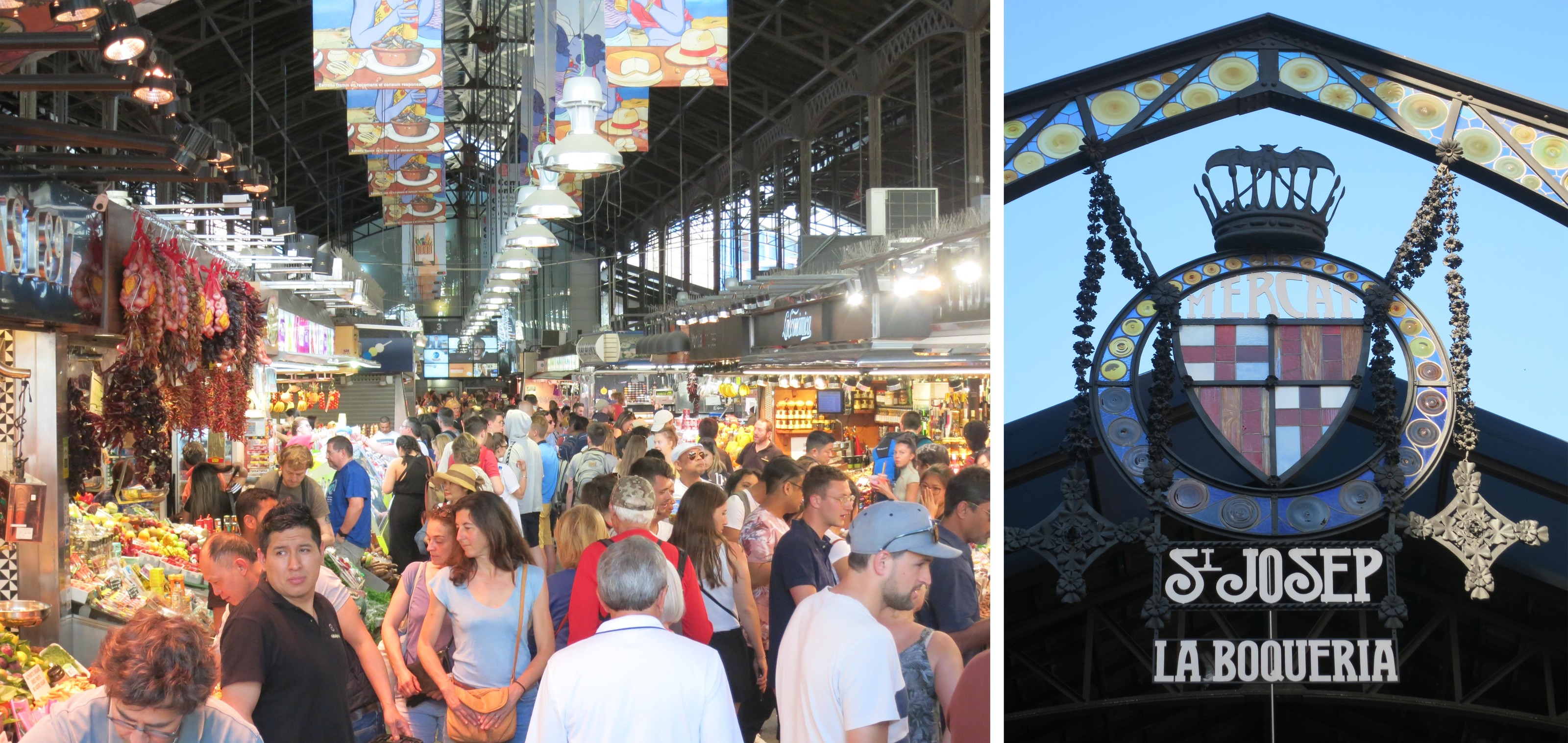
The 39 – yes, 39 – municipal food markets of Barcelona provide a wide variety of visual, auditory, and olfactory experiences. The most popular of these is La Boqueria, with more than 160 stalls and a prominent location on La Rambla de Catalunya. Although the locals do complain at times that the sheer number of visitors is changing its character, it still acts very much as a neighborhood serving market. Looking for a cut of meat? You'll have 37 butchers' stands to choose from (10 selling beef, lamb and veal; 23 selling pork products, and four specializing in offal). Fancy a piece of fish or salt cod for dinner? One of the 36 fishmongers will surely have something to your liking.
Officially named
the Mercat de St Josep (the name of the convent that occupied the site before
it was destroyed during one of the many riots that punctuated that City's
turbulent history), La Boqueria owes its existence to the city's attempts in
the late 18th century to control food supply and food pricing. In the
days before fertilizers, pesticides, refrigeration and railways, cities were
very much at the mercy of the vagaries of climate, with any kind of food
shortage leading to price gouging and popular unrest. A significant
grain famine in 1789 caused massive unrest throughout Europe, including a
revolution in France with many lost heads. The authorities in Barcelona,
however, kept theirs, and created the municipal markets, where prices could be controlled
during times of food shortages.
Through an extensive (and expensive) program of renovations, Barcelona is ensuring the continued relevance of its markets. A typical renovation will entail erecting a temporary market on nearby land to accommodate vendors, shoring up the entire building structure to allow for the excavation of an underground parking garage below the market, and upgrading finishes and infrastructure – a process that can take two to three years.
Whilst La Boqueria is the best known and the largest of the markets, it is neither as attractive, dramatic or authentic as many of the other neighborhood markets. Listed below are some of my favorites; the best time to visit is usually around lunchtime, a perfect time to grab some tapas at one of the market stalls!
1. Most Gaudi-esque: Mercat de Santa Caterina 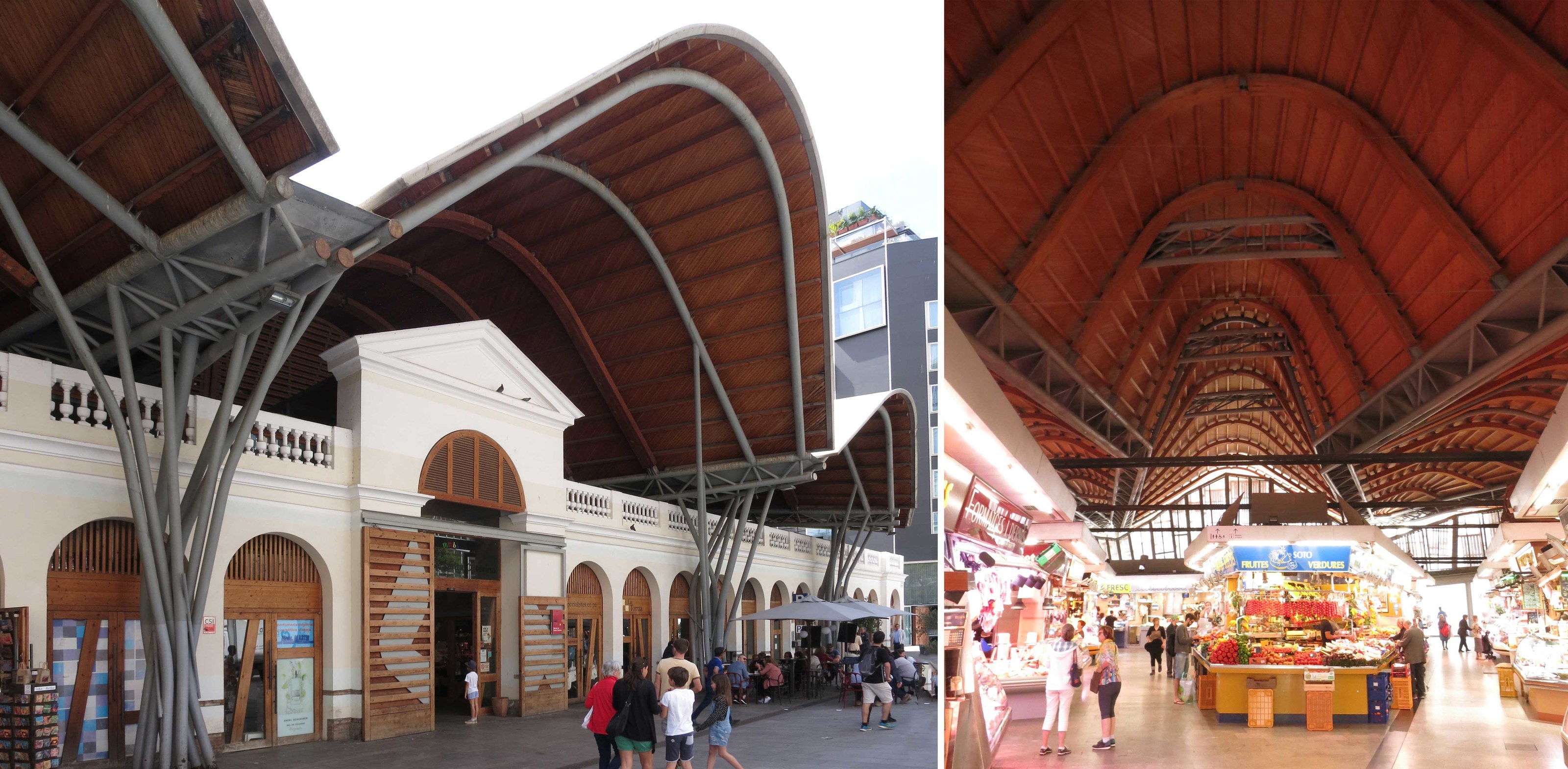
Santa
Caterina is a marvel of architectural rehabilitation, the masterpiece of local
architect Enric Miralles, who like Gaudi died before the completion of his best
known work. Located just a three-minute walk from Barcelona's Gothic
Cathedral, Santa Caterina underwent a substantial renovation in the 80's,
getting new storefronts and an extraordinary new roof, a contemporary timber
and tile reinterpretation of the Catalan vault.
The bundled metal columns and soaring ceilings evoke the Gothic architecture
of the nearby cathedral. Grab a table in front of the market and enjoy
breakfast at La Torna, then check out the amazing selection of gourmet olive
oil at the Olis Oliva store.
Market hours:
7:30 am to 8:30 pm, Tuesday, Thursday, Friday
7:30 am to 3:30 pm, Wednesday, Saturday, Monday
Closed on Sundays
Getting there:
Santa Caterina is an easy walk from the Barrio Gotico district; alternatively, take the red line to the Urquinaona Metro stop and walk three blocks.
Lunch recommendation: For inexpensive bites try Bar Joan at the back of the market; for a splurge go to the Cuines Santa Caterina restaurant at the front.
2. Most authentic: Mercat de Sants
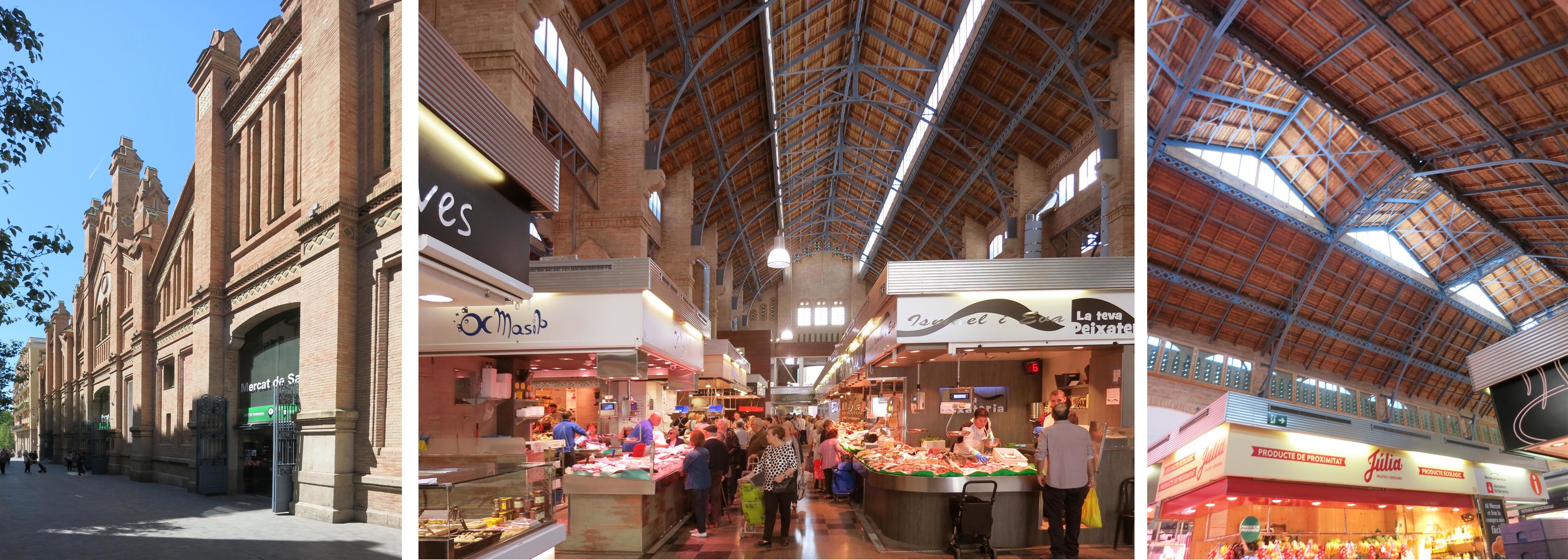 The
Mercat de Sants is my favorite market, located in the old workingclass
neighborhood of Sants, a village absorbed by Barcelona's huge expansion in the
late 19th Century. Sants is a brick "modernista" masterpiece
completed in 1914, and lovingly restored in 2014 to mark its centenary.
Like many of the restored markets, Sants features an interesting mix of uses,
designed to ensure its continued relevancy as shopping habits change: it now
has an underground parking garage, a small supermarket, over 100 traditional
food stalls in the main part of the market, and soft goods stalls along the
outside facade of the building. Frequented mostly by locals rather than
tourists, Sants feels like the "real" Barcelona.
The
Mercat de Sants is my favorite market, located in the old workingclass
neighborhood of Sants, a village absorbed by Barcelona's huge expansion in the
late 19th Century. Sants is a brick "modernista" masterpiece
completed in 1914, and lovingly restored in 2014 to mark its centenary.
Like many of the restored markets, Sants features an interesting mix of uses,
designed to ensure its continued relevancy as shopping habits change: it now
has an underground parking garage, a small supermarket, over 100 traditional
food stalls in the main part of the market, and soft goods stalls along the
outside facade of the building. Frequented mostly by locals rather than
tourists, Sants feels like the "real" Barcelona.
Market hours:
8:00 am to 8:30 pm, Tuesday through Friday
8:00 am to 2:30 pm, Saturday and Monday
Closed on Sundays
Getting there: Sants is a two-minute walk from the Placa de Sants Metro station, on the blue and red lines.
Lunch recommendation: Stop by Menjars Casolans Montero and enjoy a "tortilla de patatas," the traditional Catalan potato omelet.
3. Most likely to save your relationship: Mercat de la Concepcio
 Concepcio
is a three-naved glass and cast iron market in the Guimard style completed in
1888 and renovated in 1998. Enter the market from the south side across the new
pedestrian bridge that spans over a basement grocery store, walk past the usual
assortment of meat, fish, and vegetables, and you'll get to what makes
this market truly special: an extraordinary array of potted plants and cut
flowers. The market is known amongst locals as the Mercat de les Flors or
"Market of the Flowers," and if you need a last minute gift, or if
you've had an argument with your significant other in the wee hours of the
night, then luck would have it that this part of the market is open
24 hours a day, 365 days a year... We have to wonder how many relationships
this place has saved!
Concepcio
is a three-naved glass and cast iron market in the Guimard style completed in
1888 and renovated in 1998. Enter the market from the south side across the new
pedestrian bridge that spans over a basement grocery store, walk past the usual
assortment of meat, fish, and vegetables, and you'll get to what makes
this market truly special: an extraordinary array of potted plants and cut
flowers. The market is known amongst locals as the Mercat de les Flors or
"Market of the Flowers," and if you need a last minute gift, or if
you've had an argument with your significant other in the wee hours of the
night, then luck would have it that this part of the market is open
24 hours a day, 365 days a year... We have to wonder how many relationships
this place has saved!
Market hours (food market):
8:00 am to 8:00 pm, Tuesday through Friday
8:00 am to 3:00 pm, Saturday and Monday
Closed on Sundays
Market hours (flower market):
Open 24/7
Getting there: La Concepcio is in the Eixample neighborhood, a short three-block walk from Gaudi's Casa Battlo – or, walk one block from the Girona Metro on the yellow line.
Lunch recommendation: Rather than eating in the market, try Sopa de Pedres, a small local restaurant tucked in the alleyway just to the east of the market.
4. Most church-like: Mercat de Sant Antoni
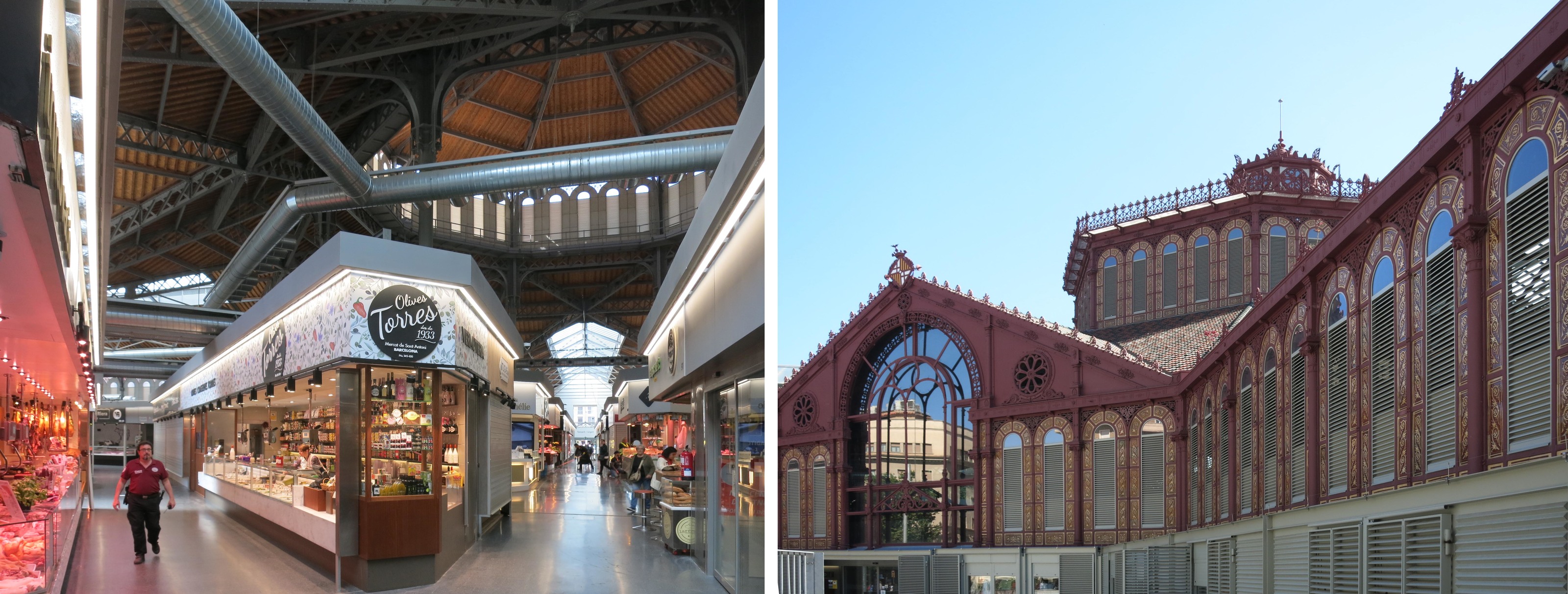 Sant
Antoni is what you end up with when you combine a church with a market with a
shopping mall. Resembling a 19th century iron and glass reinterpretation
of a centrally planned Renaissance church, Sant Antoni rises regally above its
surroundings, set back from the street edge, its diagonal orientation giving it
even more of a civic grandeur than is customary with municipal markets. A
three-year, $70 million effort restored the building's beautiful iron and
ceramic tile facade to its original splendor and added an underground garage.
Inside, there are two markets wrapped around each other: a perimeter market of
soft goods, with more than 80 vendors vendors selling clothing toys,
accessories, and kitchenware; and a central market with the usual assortment of
fish, meat, charcuterie, fruits, and vegetables.
Sant
Antoni is what you end up with when you combine a church with a market with a
shopping mall. Resembling a 19th century iron and glass reinterpretation
of a centrally planned Renaissance church, Sant Antoni rises regally above its
surroundings, set back from the street edge, its diagonal orientation giving it
even more of a civic grandeur than is customary with municipal markets. A
three-year, $70 million effort restored the building's beautiful iron and
ceramic tile facade to its original splendor and added an underground garage.
Inside, there are two markets wrapped around each other: a perimeter market of
soft goods, with more than 80 vendors vendors selling clothing toys,
accessories, and kitchenware; and a central market with the usual assortment of
fish, meat, charcuterie, fruits, and vegetables.
Market hours:
8:00 am to 8:30 pm, Monday through Saturday
Closed on Sundays
Getting there: Located on the edge of the Raval neighborhood, Sant Antoni is a 12-minute walk from La Boqueria, and adjacent to the Sant Antoni stop on the purple line.
Lunch recommendation: Enjoy a couple of empanadas from the wonderful selection at Rekons.
5. Most cathedral-like: Mercat de Galvany
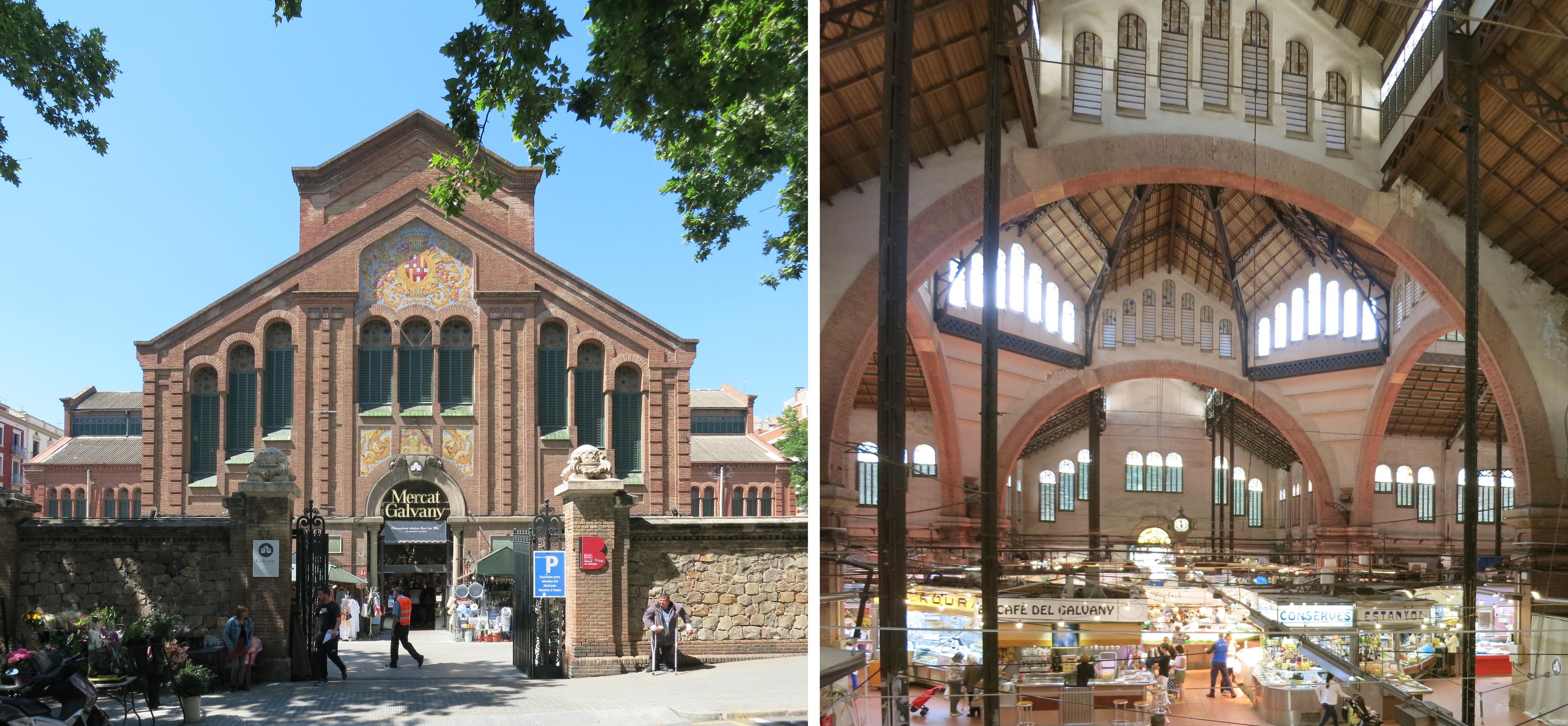 If
Sant Antoni is a church of shopping, then Galvany deserves the title of
Cathedral of Commerce: four naves lead you to an altar of fishmongers in the
center of the market, crowned by a large, octagonal dome resting on four
soaring arches. Like many other markets, the fishmongers in Galvany are
located in the center of the covered markets for both symbolic and practical
reasons: to remind the citizens of Barcelona of their city’s maritime roots,
and to take advantage of the movement of air in the naturally ventilated
buildings, with fresh air coming in through the perimeter doors then rising as
it reaches the middle of the space. One of the few markets that has not been
renovated, Galvany does show a little wear and tear that adds to its charm,
although one hopes that any remodel will get rid of the awful fluorescent
lighting that distracts from the awe-inspiring ceiling.
If
Sant Antoni is a church of shopping, then Galvany deserves the title of
Cathedral of Commerce: four naves lead you to an altar of fishmongers in the
center of the market, crowned by a large, octagonal dome resting on four
soaring arches. Like many other markets, the fishmongers in Galvany are
located in the center of the covered markets for both symbolic and practical
reasons: to remind the citizens of Barcelona of their city’s maritime roots,
and to take advantage of the movement of air in the naturally ventilated
buildings, with fresh air coming in through the perimeter doors then rising as
it reaches the middle of the space. One of the few markets that has not been
renovated, Galvany does show a little wear and tear that adds to its charm,
although one hopes that any remodel will get rid of the awful fluorescent
lighting that distracts from the awe-inspiring ceiling.
Market hours:
7:00 am to 2:00 pm, Monday through Saturday
Closed on Sundays
Getting there: Galvany is a little more out of the way, but can be easily reached by taking the light rail from the Placa de Catalunya terminus to the Muntaner station.
Lunch recommendation: El Café de Galvany is a classic market bar. Enjoy your tapas there while staring at the soaring ceiling vaults.
Other markets
The list of municipal markets in Barcelona is long. Depending on which neighborhoods your wanderings take you to, the following markets are also worth checking out:
- Barceloneta neighborhood: Mercat de la Barceloneta (the best sardines I've ever tasted)
- Vila de Gracia neighborhood: Mercat de La Llibertat (a neighborhood jewel in the Guimard style)
- Eixample neighborhood: Mercat Del Ninot (a plethora of lunch choices)

Related Articles