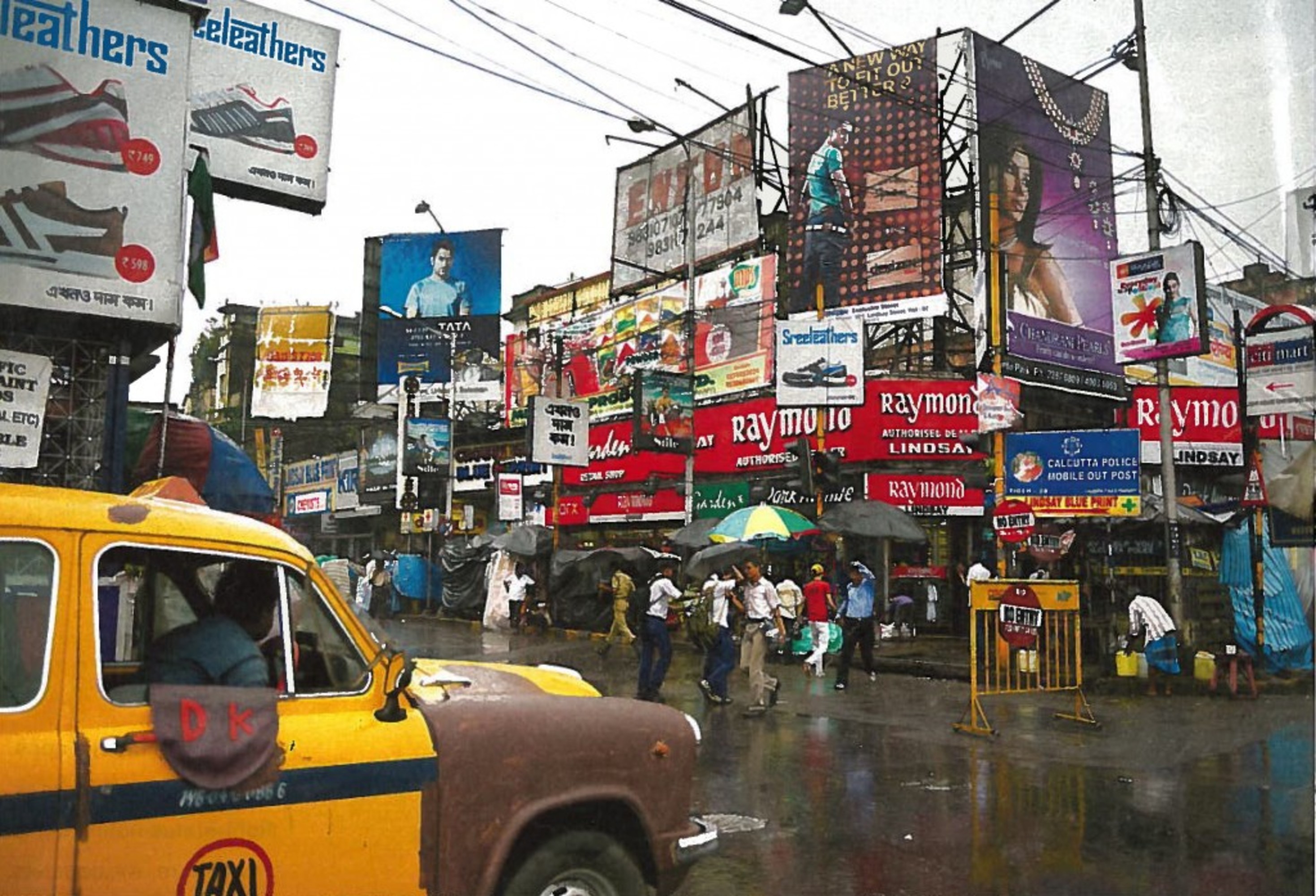
This photo of an intersection in Kolkata, India, recently published in the New York Times Magazine, reminded me of the impact of retail signage on our urban environments, and of the fine line between urban vitality and complete and utter chaos (and can you spot the sign for the police sub-station?). Of course this isn’t necessarily a problem in North America, where architects and planners tend to over-design, over-plan and over-regulate cities to the point of draining life out of them, with retail signage often perceived as public enemy number 1 (here in San Francisco we had a voter-approved billboard ban not too many years ago, including Market Street of all places, which most emphatically should have more billboards). Personally I think it’s time for both the architectural and planning professions to rethink their approach to urban design and the role that signage can play in enriching our environments. Some of the more enthralling public spaces that are defined by exuberant signage include Piccadilly Circus in London, and of course Times Square in New York City – not necessarily places to take the dog for a walk, but certainly magnets for tourists and 20-somethings who want to experience a burst of urban adrenaline. Personally, I have always been struck by the prominence of signage when looking at historical photos of American Main Streets – one can only speculate that these date from before the time signage ordinances were invented. This photo from turn-of-the-century Salt Lake City is a wonderful example of the variety and exuberance of signage that once adorned America’s Main Streets (and of course it bears a striking resemblance to our example from across the world in India!)

Who knew that Salt Lake City once had so much in common with present-day Kolkata? And is it time to reassess the contribution that signage can make as we work towards infusing our retail neighborhoods with magnetism, energy and vitality?
Smith Drug Store Corner at 200 South and Main Street – the Piccadilly Circus/Times Square of Salt Lake City, circa 1910
Who knew that Salt Lake City once had so much in common with present-day Kolkata? And is it time to reassess the contribution that signage can make as we work towards infusing our retail neighborhoods with magnetism, energy and vitality?

Related Articles
08.11.20
How Animation Changed My Design Approach
Architecture is a way of seeing things. That’s why digital
visualization tools have been so impactful: not because they moved us from
paper to the ...
12.02.19
If Architecture is Frozen Music, Should Retail Architecture be Frozen Muzak?
"Music is liquid
architecture; architecture is frozen music."— Johann Wolfgang von Goethe
The Oculus, Santiago
Calatrava's vast ribbed structure ...
10.23.19
Five Favorite Markets of Barcelona
The 39 – yes, 39 – municipal food markets of Barcelona provide a wide
variety of visual, auditory, and olfactory experiences. The most popular...